Build method-specific NDT knowledge through classroom, online and recorded learning options.
Explore practical NDT learning, method fundamentals and career-oriented preparation with NDTCTC.
Flexible NDT learning paths for different experience levels and career goals.
For those who are already having an experience of minimum 2 years or more in NDT.
All the basic methods overview will be given
special focus is given in thes specific method where the candidate is having experience
Interview Orientation and specific Country oriented topics are covered including Safety
for individuals who are willing to work overseas and wanted to have career advancement
•Delivery: Online live classes or in-person at Visakhapatnam/Hyderabad centers.
•Cost: Starting at ₹30,000, with flexible installment plans.
•Outcome: Level II-focused training and course documentation; confirm the applicable certification scheme and employer requirements with our advisor.
Enquire NowFor those who are already having an experience of minimum 2 years or more in NDT.
All the basic methods overview at advanced level will be given
Special focus is given to the method in which the candidate already has experience.
Interview Orientation and specific Country oriented topics are covered including Safety
for individuals who are willing to work overseas and wanted to have career advancement
Delivery: Online live classes or in-person at Visakhapatnam/Hyderabad centers, together with hands-on training at available labs.
Cost: Starting at ₹60,000, with flexible installment plans.
Outcome: Advanced Level II-focused training, interview preparation and course documentation. Recognition depends on the applicable employer and certification scheme.
Enquire NowOur extended program combines technical learning, practical exposure, interview preparation and structured career support.
•NDT Career Program: Covers all the methods in an advanced level
•Advanced NDT Training: Refresher preparation based on the selected method and assessment requirement.
•Professional Development: Includes a well organized training program and at the end of training the candidate will be fully confident
•Employer interview opportunities may be coordinated when suitable vacancies and candidate eligibility align.
•Delivery: Blended learning with extended practical sessions in Visakhapatnam.
By the end of Training program a complete Road map is provided for the next 5 years for career advancement.
•Career Support: CV guidance, interview preparation and vacancy referrals in India and overseas. Employment is not guaranteed and depends on qualifications, performance and market demand.
Enquire NowOverview of available method-specific NDT training programs.
| NDT Method | Training Level | Duration | Learning Format | Relevant Job Areas |
|---|---|---|---|---|
| Radiography Testing (RT) | Level II | 1 Month | Theory + practical | RT Inspector, NDT Technician |
| Ultrasonic Testing (UT) | Level II | 1 Month | Theory + practical | UT Inspector, NDT Technician |
| Magnetic Particle Testing (MT) | Level II | 15 days | Theory + practical | MT Inspector, NDT Technician |
| Penetrant Testing (PT) | Level II | 15 days | Theory + practical | PT Inspector, NDT Technician |
| Ultrasonic Testing (UT) T,K,Y Joints | Level II | 1 month | Theory + practical | UT T,K,Y Inspector |
| Phased Array UT (PAUT) | Level II | 1 month | Theory + practical | Advanced UT Inspector |
| Time of Flight Diffraction (TOFD) | Level II | 1 month | Theory + practical | Specialized UT Inspector |
| Visual Testing (VT) | Level II | 1 month | Theory + practical | Visual Inspector |
| Electromagnetic Testing (ET) | Level II | 1 month | Theory + practical | ET Inspector |
| Radiographic Testing Film Interpretation (RTFI) | Level II | 1 month | Theory + practical | RTFI Inspector |
| Tube Inspection (IRIS,MFL,ECT,RFET) | Level II | 2 month | Theory + practical | Advanced NDT Inspector |
| MFL Tank Bottom Floor Inspection (MFL) | Level II | 1 month | Theory + practical | Advanced NDT Inspector |
| Ultrasonic Testing Corrosion Mapping | Level II | 1 month | Theory + practical | Advanced NDT Inspector |
Program delivery can combine theory, demonstrations and practical sessions, depending on the selected course format.
Certificate scope and recognition depend on the applicable written practice, employer and client requirements. Ask the course advisor to confirm the scheme before enrolment.
Independent refresher preparation for experienced NDT personnel working toward employer- or client-controlled assessments.
| Refresher Program | Duration | Preparation Focus | Target Region | Intended Audience |
|---|---|---|---|---|
| Saudi Aramco RPP refresher preparation | 1 month | RPP assessment preparation | Saudi Arabia | Experienced NDT personnel preparing for client-specific project assessments |
| Saudi Aramco RT refresher preparation | 1 month | RT assessment preparation | Saudi Arabia | Experienced NDT personnel preparing for client-specific project assessments |
| Saudi Aramco UT theory and practical refresher preparation | 1 month | UT assessment preparation | Saudi Arabia | Experienced NDT personnel preparing for client-specific project assessments |
| Saudi Aramco PAUT refresher preparation | 1 month | PAUT assessment preparation | Saudi Arabia | Experienced NDT personnel preparing for client-specific project assessments |
| Saudi Aramco tube-inspection refresher preparation | 1 month | Tube-inspection assessment preparation | Saudi Arabia | Experienced NDT personnel preparing for client-specific project assessments |
| Saudi Aramco tank MFL refresher preparation | 1 month | Tank MFL assessment preparation | Saudi Arabia | Experienced NDT personnel preparing for client-specific project assessments |
| Saudi Aramco RT refresher preparation Film Interpretation | 1 month | RTFI assessment preparation | Saudi Arabia | Experienced NDT personnel preparing for client-specific project assessments |
Refresher preparation is intended for experienced personnel who meet the applicable employer and client prerequisites.
NDTCTC provides training and preparation only. It does not issue Saudi Aramco approval, authorization or qualification.
Final eligibility, examination, authorization and approval remain under the applicable employer and client process.
Preparation scope can be discussed for other client-specific requirements in Saudi Arabia and Gulf markets.
Understanding the technical principles and applications of various NDT techniques
Radiography Testing (RT) is a non-destructive testing method that uses penetrating radiation to examine internal structures of materials and components.
RT is widely used in weld inspection, casting examination, and quality control in manufacturing processes. It's particularly effective in:
Ultrasonic Testing utilizes high-frequency sound waves to detect internal flaws and measure material properties. This versatile method provides real-time imaging and precise measurements.
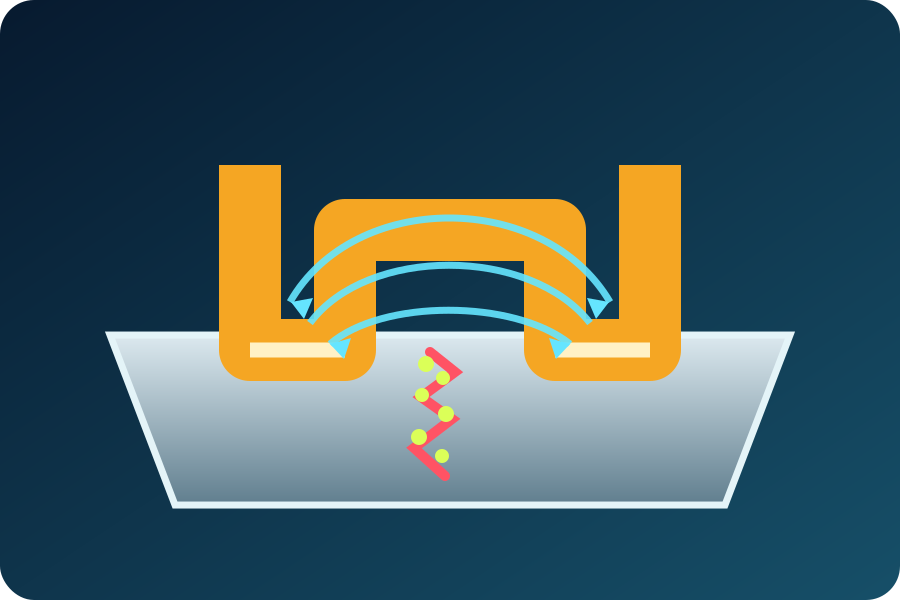
Magnetic Particle Testing is used to detect surface and near-surface discontinuities in ferromagnetic materials by creating magnetic fields and using fine magnetic particles.
Liquid Penetrant Testing is a widely used method for detecting surface-breaking discontinuities in non-porous materials, utilizing the capillary action of special dye penetrants.
Visual Testing is the most basic and widely used NDT method, involving systematic examination of materials and components using the human eye or optical instruments.
Phased Array Ultrasonic Testing (PAUT) is an advanced NDT method that utilizes multiple ultrasonic elements to create customized wave patterns for enhanced inspection capabilities.
TOFD is a specialized ultrasonic technique that uses time of flight of diffracted sound waves to detect and size defects with high accuracy.
RTFI is a specialized skill in analyzing and interpreting radiographic films to detect and evaluate internal defects in materials and welds.
Comprehensive tube inspection combines multiple NDT methods to assess the condition of heat exchangers, boilers, and other tubular components.
MFL is a method used for detecting metal loss and corrosion in ferromagnetic materials, particularly effective for tank floor inspection.
Advanced ultrasonic technique for creating detailed maps of material thickness and corrosion patterns in vessels and pipelines.
ET uses electromagnetic principles to detect surface and near-surface flaws in conductive materials without direct contact.
Visual reference guide for various NDT techniques and equipment
Common questions about our NDT training programs
Basic eligibility includes a diploma or degree in engineering/science fields. However, candidates with technical aptitude and relevant experience are also considered.
Placement assistance can include CV guidance, interview preparation and referrals to suitable vacancies. Employment is not guaranteed and depends on qualifications, performance, experience and employer demand.
Recognition depends on the applicable certification scheme, employer written practice and client requirements. Contact the course advisor before enrolment to confirm the certificate issuer and scope for your intended job market.
Yes, our programs cater to both beginners and experienced professionals. We recommend our long-term course for those without prior experience.
Published online courses can be purchased through the secure NDTCTC eLearning portal. Contact the course advisor to confirm classroom fees, instalment availability and any current scholarship criteria.
Eligibility criteria for our NDT training programs
Contact us today to learn more about our NDT training programs and how they can help you achieve your career goals.
Get in Touch